Python multipart/form-data Parser Benchmark
This benchmark covers the most commonly used Python parsers for multipart/form-data (HTML5 forms) and tests them in different scenarios, comparing both blocking and non-blocking (async) APIs if
available. Source code is available here: https://github.com/defnull/multipart_bench/
The multipart library is used as a baseline, because it is currently the fastest pure-python parser tested and also the reason I'm benchmarking parsers in the first place.
Contestants
- multipart v2.0.0
- Used in Bottle, LiteStar, Zope and others.
- CPython docs recommend it as a
cgi.FieldStoragereplacement. - Disclaimer: I am the author and maintainer of this library.
- werkzeug v3.1.8
- Used in Flask and others.
- Does a lot more than just multipart parsing.
- django v6.0.7
- Full featured web framework, not just a parser.
- python-multipart v0.0.32
- streaming-form-data v2.1.0
- Partly written in Cython.
- emmett-core v1.4.1
- Mostly written in Rust.
- Similar to Django or werkzeug, this library does a lot more than just multipart parsing. It is not a stand-alone parser, but a support library for the emmett framework and rarely used outside of this context.
- cgi.FieldStorage CPython 3.12.3
- Deprecated in Python 3.11 and removed in Python 3.13
- email.parser.BytesFeedParser CPython 3.12.3
- Designed as a parser for emails, not
multipart/form-data. - Buffers everything in memory, including large file uploads.
- Designed as a parser for emails, not
Not included: Some parsers cheat by loading the entire request body into memory (e.g. sanic or litestar before they switched to multipart). Those are obviously very fast in benchmarks but also very unpractical when dealing with large file uploads.
Updates
- 30.09.2024
python-multipartv0.0.11 fixed a bug that caused extreme slowdowns (as low as 0.75MB/s) in all three worst-case scenarios. - 30.09.2024 There was an issue with the
emailparser that caused it to skip over the actual parsing and also not do any IO in the blocking test. Throughput was way higher than expected. This is fixed now. - 30.09.2024 Default size for in-memory buffers is different for each parser,
resulting in an unfair comparison. The tests now configure a limit of 500K for
each parser, which is the hard-coded value in
werkzeugand also a sensible default. - 03.10.2024 New version of
multipartwith slightly better results in some tests. - 05.10.2024 Added results for
streaming-form-dataparser. - 25.10.2024 Added results for
djangoparser. - 06.11.2024 Added results for
emmett-coreparser. - 24.12.2024 New versions for many libraries and an additional "worstcase_junk" scenario. The results were so bad for some of the libraries that I reported it as a potential security issue (DoS vulnerability) to the most affected libraries and waited for a fix to be available before publishing results.
- 09.07.2026 A lot has happened and new versions were released. I updated the benchmark runner to report mean throughput instead of the 'best' result of all runs, and let it run for as long as necessary to achieve stable results. This should reduce the impact of noise and give more realistic results. I also render some plots now. Enjoy :)
Method
All tests were performed on a pretty old "AMD Ryzen 5 3600" running Linux 6.17.0 and Python 3.12.3 with highest possible priority and pinned to a single core.
For each test, the parser is created with default¹ settings and the results are
thrown away. Some parsers buffer to disk, but TEMP points to a ram-disk to
reduce disk IO from the equation. Each test is repeated until the relative
confidence interval around the trimmed² average runtime is narrow enough, then
the scenario input size is divided by that runtime to get a nice MB/s throughput
estimate per core.
The fastest pure-python parser (currently multipart) is used as the 100% baseline
for each test. This ensures that pure python parsers are always easy to compare
against each other, and parsers written in compiled languages can be included without
screwing with the results too much.
¹) There is one exception: The limit for in-memory buffered files is set to
500KB (hard-coded in werkzeug) to ensure a fair comparison.
²) We ignore the top and bottom 10% of all measurements per test to remove extreme
outliers, but still keep realistic outliers that may actually happen during
real-world operation due to allocation pressure or context switches.
Results
Parser throughput is measured in MB/s (input size / time). Higher throughput is better.
Scenario: simple
Description: A simple form with just two small text fields.
This scenario is so small that it shows initialization and interpreter overhead
more than actual parsing performance, which benefits emmett-core the most
because everything happens in Rust and outside of the python runtime. The results
for streaming-form-data are a bit surprising though, given that it is partly
written in Cython and compiled to native code. My guess is that there is some
significant overhead when calling Python callbacks from Cython, which happens a
lot in this test. When comparing the pure-python parsers, multipart is the
clear winner.
Note: Small forms like these should better be transmitted as
application/x-www-form-urlencoded, which has a lot less overhead compared to
multipart/form-data and should be a lot faster to parse, so take this benchmark
with a large grain of salt. This is an uncommon and artificial scenario.
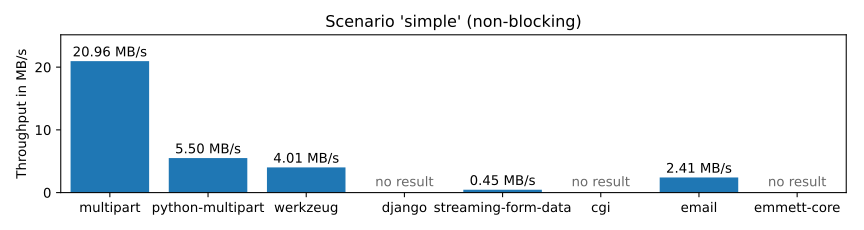
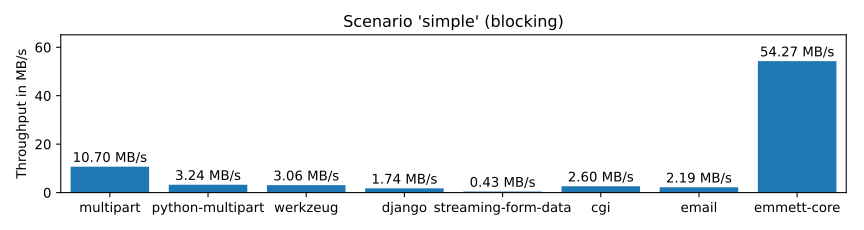
| Parser | Non-Blocking (MB/s) | Blocking (MB/s) |
|---|---|---|
| multipart | 20.96 MB/s (100%) | 10.70 MB/s (100%) |
| python-multipart | 5.50 MB/s (26%) | 3.24 MB/s (30%) |
| werkzeug | 4.01 MB/s (19%) | 3.06 MB/s (29%) |
| django | - | 1.74 MB/s (16%) |
| streaming-form-data | 0.45 MB/s (2%) | 0.43 MB/s (4%) |
| cgi | - | 2.60 MB/s (24%) |
| 2.41 MB/s (11%) | 2.19 MB/s (20%) | |
| emmett-core | - | 54.27 MB/s (507%) |
Scenario: large
Description: A large form with 100 small text fields.
This scenario benefits parsers with low per-field overhead or a line-based
parser design (like cgi and email) because each field is just a single line,
and there are a lot of them. Initialization overhead is less important here
compared to the 'simple' scenario above.
No surprise that emmett-core performs well here, because the payload still
fits in a small number of chunks and other than streaming-form-data the parser
does not have to call into Python code for each field. The Rust parser thus
completely bypasses the python interpreter overhead. email also performs
reasonably well, as it is designed for this type of line-based text input and
even surpasses many of the other pure-python parsers, but multipart is still
more than three times as fast.
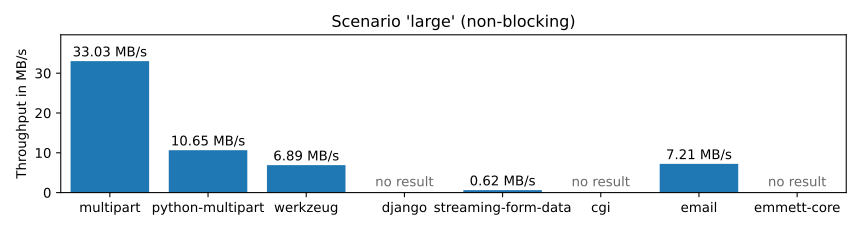
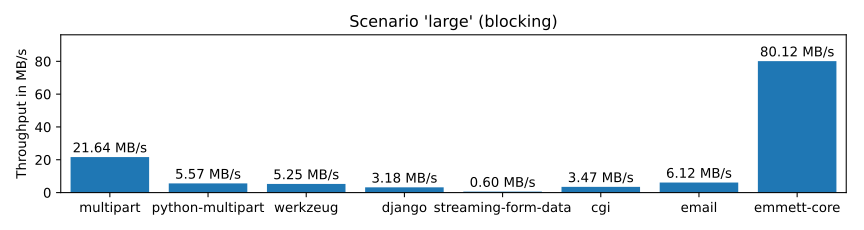
| Parser | Non-Blocking (MB/s) | Blocking (MB/s) |
|---|---|---|
| multipart | 33.03 MB/s (100%) | 21.64 MB/s (100%) |
| python-multipart | 10.65 MB/s (32%) | 5.57 MB/s (26%) |
| werkzeug | 6.89 MB/s (21%) | 5.25 MB/s (24%) |
| django | - | 3.18 MB/s (15%) |
| streaming-form-data | 0.62 MB/s (2%) | 0.60 MB/s (3%) |
| cgi | - | 3.47 MB/s (16%) |
| 7.21 MB/s (22%) | 6.12 MB/s (28%) | |
| emmett-core | - | 80.12 MB/s (370%) |
Scenario: upload
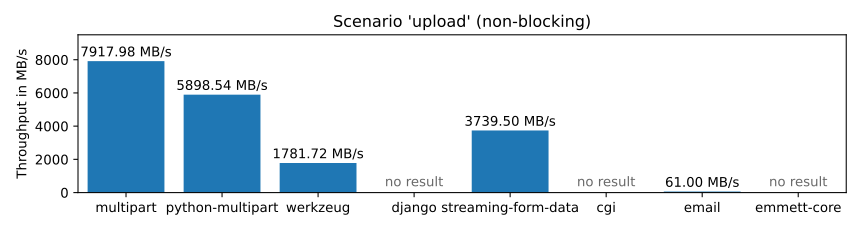
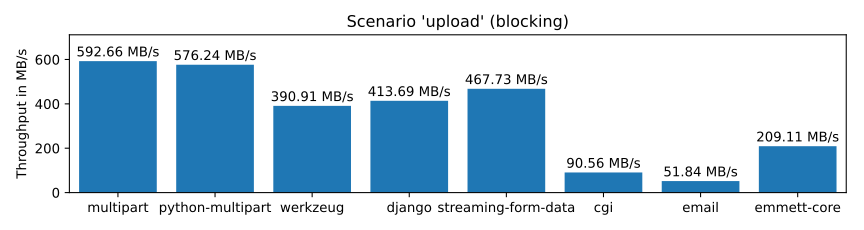
Description: A file upload with a single large (32MB) file.
Now it gets interesting! When dealing with actual file uploads, both
python-multipart and streaming-form-data catch up and are now faster than
werkzeug or django. All four are slower than multipart, but the results
are still impressive. The line-based cgi and email parsers on the other hand
struggle a lot, probably because there are some line-breaks in the test file
input. This flaw shows even more in some of the tests below.
What really surprised me here was the poor performance of emmett-core. It
should be the fastest parser in all scenarios (because "Rust") but in the first
test that actually moves some bytes, it falls back significantly. My best guess
is that the context translation overhead between Python and the native Rust code
is to blame. The parser is fed chunks of bytes and each round involves call-overhead
and expensive copy operations. Pure python code can work directly with the
provided byte string and avoid some of that overhead. But that's just a guess.
| Parser | Non-Blocking (MB/s) | Blocking (MB/s) |
|---|---|---|
| multipart | 7917.98 MB/s (100%) | 592.66 MB/s (100%) |
| python-multipart | 5898.54 MB/s (74%) | 576.24 MB/s (97%) |
| werkzeug | 1781.72 MB/s (23%) | 390.91 MB/s (66%) |
| django | - | 413.69 MB/s (70%) |
| streaming-form-data | 3739.50 MB/s (47%) | 467.73 MB/s (79%) |
| cgi | - | 90.56 MB/s (15%) |
| 61.00 MB/s (1%) | 51.84 MB/s (9%) | |
| emmett-core | - | 209.11 MB/s (35%) |
Scenario: mixed
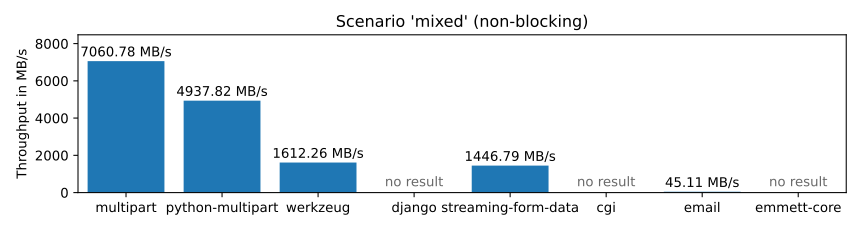
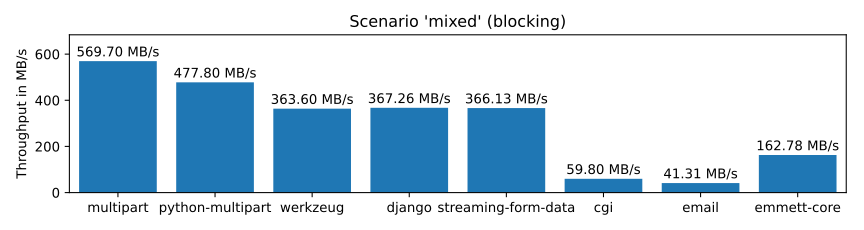
Description: A form with two text fields and two small file uploads (1MB and 2MB).
This is the most realistic test and shows similar results to the upload scenario.
streaming-form-data falls back a bit and is now closer to werkzeug and
django. emmett-core is unexpectedly slow again, slower than most modern
pure-python parsers, but still way faster than the line-based cgi and email
parsers. multipart outperforms all of them by a significant margin.
| Parser | Non-Blocking (MB/s) | Blocking (MB/s) |
|---|---|---|
| multipart | 7060.78 MB/s (100%) | 569.70 MB/s (100%) |
| python-multipart | 4937.82 MB/s (70%) | 477.80 MB/s (84%) |
| werkzeug | 1612.26 MB/s (23%) | 363.60 MB/s (64%) |
| django | - | 367.26 MB/s (64%) |
| streaming-form-data | 1446.79 MB/s (20%) | 366.13 MB/s (64%) |
| cgi | - | 59.80 MB/s (10%) |
| 45.11 MB/s (1%) | 41.31 MB/s (7%) | |
| emmett-core | - | 162.78 MB/s (29%) |
Scenario: worstcase_crlf
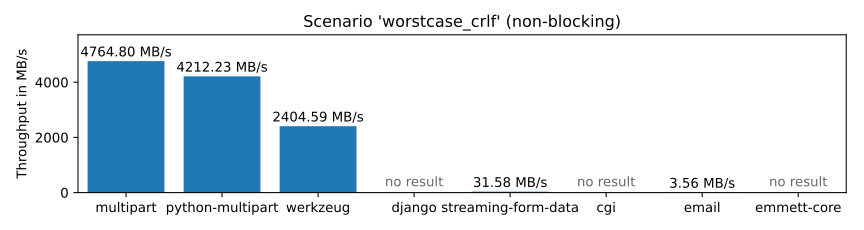
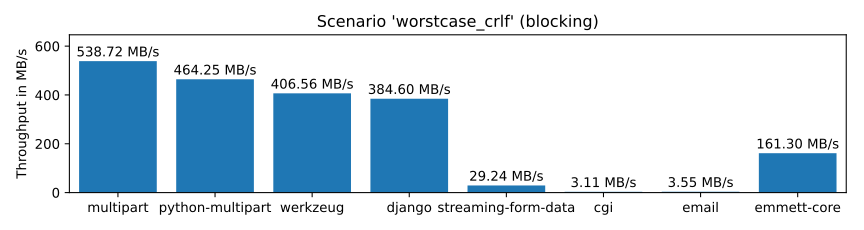
Description: A 1MB upload that contains nothing but windows line-breaks.
This is the first scenario that should not happen under normal circumstances
but is still an important test if you want to prevent malicious uploads from
slowing down your web service. multipart, python-multipart, werkzeug and
django are mostly unaffected and produce consistent results. emmett-core is
still slower than the modern pure-python parsers, but not specifically because of
this input. streaming-form-data is now several magnitudes slower than it should be,
but still faster than the line-based parsers. Those choke on the high number of
line-breaks and are practically unusable.
| Parser | Non-Blocking (MB/s) | Blocking (MB/s) |
|---|---|---|
| multipart | 4764.80 MB/s (100%) | 538.72 MB/s (100%) |
| python-multipart | 4212.23 MB/s (88%) | 464.25 MB/s (86%) |
| werkzeug | 2404.59 MB/s (50%) | 406.56 MB/s (75%) |
| django | - | 384.60 MB/s (71%) |
| streaming-form-data | 31.58 MB/s (1%) | 29.24 MB/s (5%) |
| cgi | - | 3.11 MB/s (1%) |
| 3.56 MB/s (0%) | 3.55 MB/s (1%) | |
| emmett-core | - | 161.30 MB/s (30%) |
Scenario: worstcase_lf
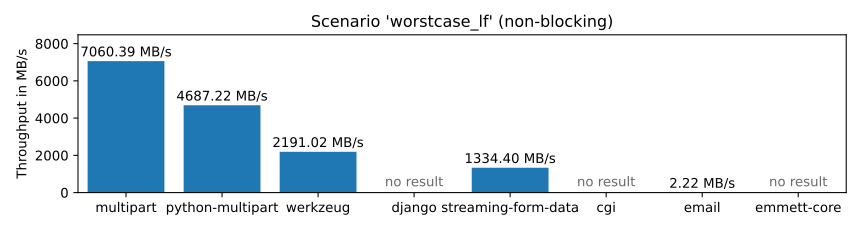
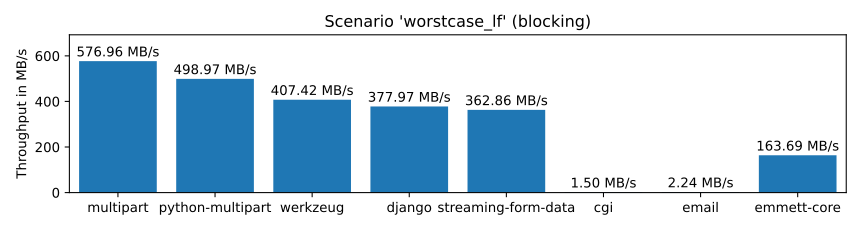
Description: A 1MB upload that contains nothing but linux line-breaks.
Linux line breaks are not valid in segment headers or boundaries, which benefits
parsers that do not try to be nice and parse invalid input for compatibility
reasons. streaming-form-data is less affected this time and performs well. The
two line-based parsers on the other hand are even worse than before. Throughput is
roughly halved, probably because there are twice as many line-breaks (and thus
lines) in this scenario.
| Parser | Non-Blocking (MB/s) | Blocking (MB/s) |
|---|---|---|
| multipart | 7060.39 MB/s (100%) | 576.96 MB/s (100%) |
| python-multipart | 4687.22 MB/s (66%) | 498.97 MB/s (86%) |
| werkzeug | 2191.02 MB/s (31%) | 407.42 MB/s (71%) |
| django | - | 377.97 MB/s (66%) |
| streaming-form-data | 1334.40 MB/s (19%) | 362.86 MB/s (63%) |
| cgi | - | 1.50 MB/s (0%) |
| 2.22 MB/s (0%) | 2.24 MB/s (0%) | |
| emmett-core | - | 163.69 MB/s (28%) |
Scenario: worstcase_bchar
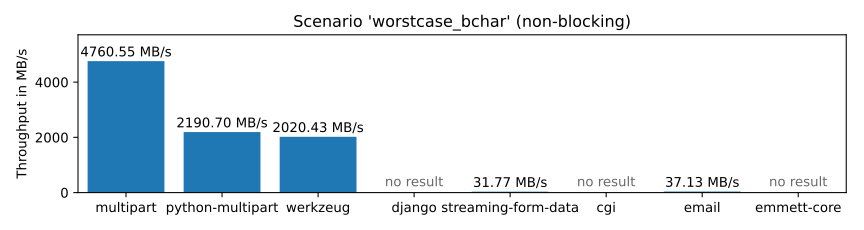
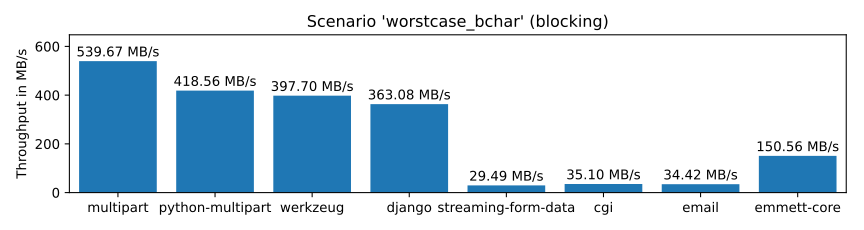
Description: A 1MB upload that contains parts of the boundary.
This test was originally added to show an issue with python-multipart, but the biggest
slowdowns were fixed quickly after reporting. It still struggles a bit and is on par
with werkzeug in this test, but both are acceptable. multipart also slows down a bit
compared to the non-malicious scenarios, but is still significantly fatser than the
others. streaming-form-data takes the biggest hit here, it is now even slower than the
line-based legacy parsers.
| Parser | Non-Blocking (MB/s) | Blocking (MB/s) |
|---|---|---|
| multipart | 4760.55 MB/s (100%) | 539.67 MB/s (100%) |
| python-multipart | 2190.70 MB/s (46%) | 418.56 MB/s (78%) |
| werkzeug | 2020.43 MB/s (42%) | 397.70 MB/s (74%) |
| django | - | 363.08 MB/s (67%) |
| streaming-form-data | 31.77 MB/s (1%) | 29.49 MB/s (5%) |
| cgi | - | 35.10 MB/s (7%) |
| 37.13 MB/s (1%) | 34.42 MB/s (6%) | |
| emmett-core | - | 150.56 MB/s (28%) |
Scenario: worstcase_junk
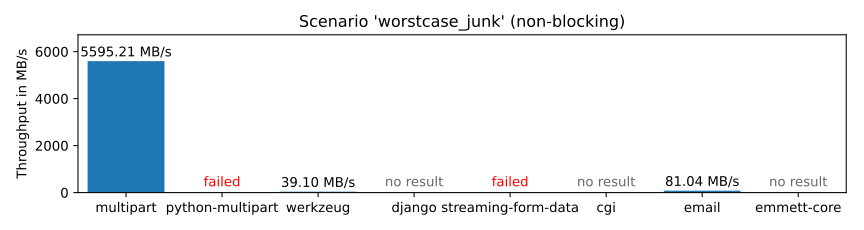
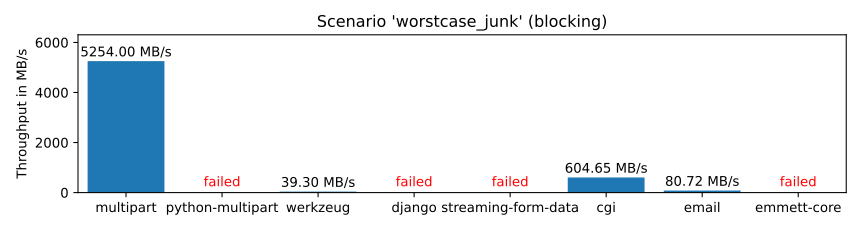
Description: Junk before the first and after the last boundary (1MB each)
The legacy multipart protocol allows arbitrary junk before the first and after the last boundary, and requires parsers to ignore it. This protocol 'feature' has no practical use and no browser or HTTP client would ever do that, but parsers still have to deal with it, one way or the other.
When this was first discovered, multipart was the only implementation not
showing a drastic slowdown in this test. All the other parsers spent way too
much time parsing and discarding junk. Some were so slow that I waited for
the most affected libraries to release fixes before I published any results, as
this may be abused for denial of service attacks, which can be a serious security
issue. The results are still really bad for most of the parsers, but not as
catastrophic as it was before. Update your dependencies!
Some of the parsers fail this test, but that's a good thing! Failing this test with a
fast exception is way better than beeing slow. Malicious input can and should be
rejected. multipart will also bail out very quickly in strict mode, but these tests
are run in default mode which accepts some amounts of unusual input for compatibility
reasons. It's still mostly unaffected, even in non-strict mode, as it manages to skip
junk fast enough.
You may have noticed that the blocking variants of most parsers are almost as fast as the non-blocking versions in this scenario. This is because 'junk' does not emit any parser events and the blocking parts of the parser do not have to do much.
| Parser | Non-Blocking (MB/s) | Blocking (MB/s) |
|---|---|---|
| multipart | 5595.21 MB/s (100%) | 5254.00 MB/s (100%) |
| python-multipart | failed | failed |
| werkzeug | 39.10 MB/s (1%) | 39.30 MB/s (1%) |
| django | - | failed |
| streaming-form-data | failed | failed |
| cgi | - | 604.65 MB/s (12%) |
| 81.04 MB/s (1%) | 80.72 MB/s (2%) | |
| emmett-core | - | failed |
Conclusion
All modern pure-python parsers (multipart, werkzeug, python-multipart) are
fast enough for most real-world use cases and behave correctly. All three offer
non-blocking APIs for asyncio/ASGI environments with very little overhead and a
high level of control. There are differences in API design, code quality,
maturity, support and documentation, but that's not the focus of this benchmark.
The django parser is also pretty solid, but hard to use outside of Django
applications.
For me, both streaming-form-data and emmett-core were a bit of a surprise.
Both are reasonably fast for large file uploads, but not as fast as you might
expect from parsers written in Cython or Rust. I would have never guessed that a
pure python parser can outperform both in the relevant tests. The overhead
introduced by those Python/native compatibility layers seems to be significant.
The results for those two parsers were also very different. Lessons learned:
Always measure. Just because something is implemented in a faster language does
not mean it's actually faster.
I probably do not need to talk much about email or cgi. Both show mixed
performance and are vulnerable to malicious inputs. cgi is deprecated (for
good reasons) and email is not designed for form data or large uploads at all.
Both are unsuitable or even dangerous to use in modern web applications.
All in all, multipart seems to be a good choice for new projects. It's highly
optimized with a strong focus on security, has 100% test coverage, no dependencies
and does exactly what it is supposed to do, in the best possible way. But don't just
take my word for it, I'm obviously biased as the author of that library. Look at the
results, look at the test cases, check out the projects, try them out and make up
your own mind.
Thanks for reading.